 Researchhub
 peer review: What Editors Assess
Last updated -ResearchHub publishes expert assessments of funding proposals to help authors improve their plans and give funders scientific context. Editors assess each critique for depth, clarity, scientific rigor, constructiveness, and professionalism before selecting reviews for ResearchCoin (RSC) compensation.
Paid reviewers need a ResearchHub account, a profile showing relevant expertise, verified identity, and authenticated ORCID. Reviews are public and appear under the reviewer's name.
Proposal Assessment Criteria
Proposal reviewers evaluate the potential contribution and feasibility of planned research. Each applicable review section requires both a rating and written feedback.
- Overall Impact
- The potential contribution of the proposed work if it succeeds.
- Importance
- The significance of the research problem and the novelty of the proposed concepts, approaches, or applications.
- Rigor and Feasibility
- Whether the methods are scientifically sound and achievable given the team's expertise, timeline, and budget.
- Additional Review Requirements
- Relevant human-subject protections, ethical approvals, regulatory requirements, and plans for sharing data and code.
For an application responding to a request for proposals (RFP), the assessment also considers how the study addresses the RFP's stated goals. ResearchHub also accepts standalone funding proposals.
Editorial Assessment of the Critique
ResearchHub editors evaluate how thoroughly and clearly the review explains its scientific judgments. Specific feedback identifies the section or method at issue, explains the limitation, and suggests an improvement where possible. Methodological concerns should remain distinct from comments about wording or presentation.
Reviewers should distinguish evidence from opinion, acknowledge uncertainty, and reference relevant literature where it supports the assessment. Vague criticism and unsupported assertions do not qualify for approval.
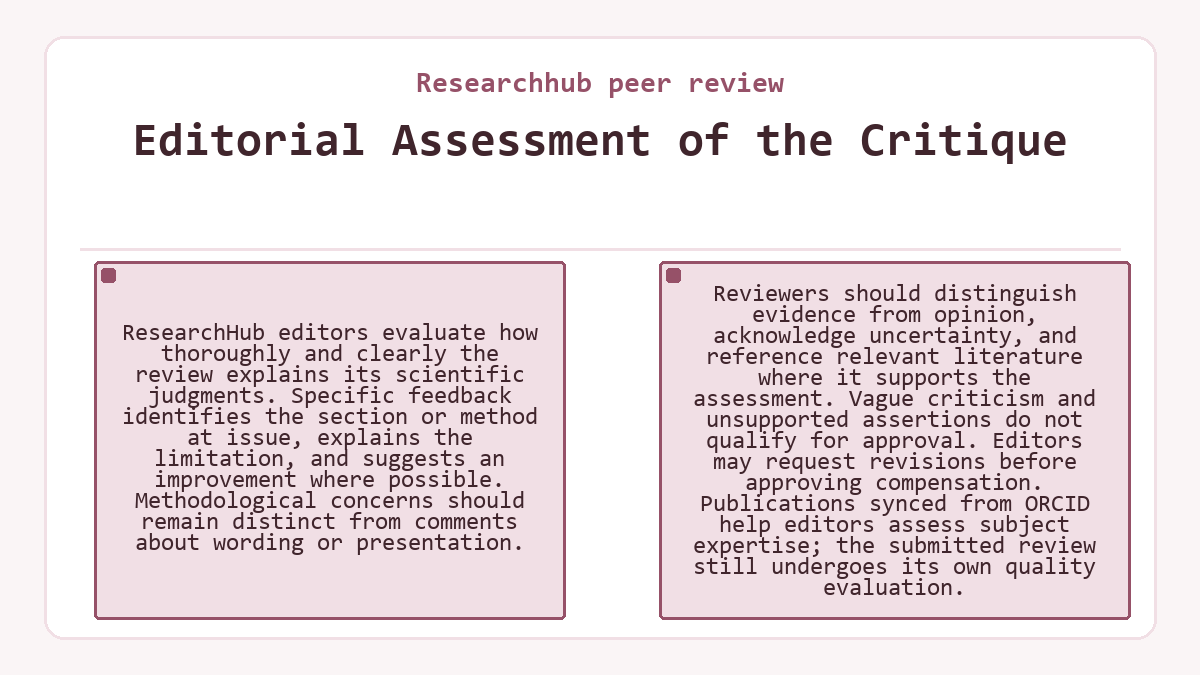
Editors may request revisions before approving compensation. Publications synced from ORCID help editors assess subject expertise; the submitted review still undergoes its own quality evaluation.
Submission Limits and Reward Conditions
Qualified reviewers may choose an open proposal bounty without an invitation. Permission to submit does not reserve a paid place: editors select reviews for compensation based on quality.
| Parameter | Published Rule | Scope and Conditions |
|---|---|---|
| Submission Allowance | Up to 2 reviews per week | The allowance applies to each reviewer, separately from the number of paid reviews available per proposal. |
| Review Length | 3000 words maximum | Reviews should prioritize substance and clarity within this limit. |
| Review Compensation | $150 USD equivalent in RSC per selected review | Up to 2 reviews per proposal receive payment through editorial selection. |
| Payment Timing | Approximately 10 days after acceptance | Reviews are typically evaluated within several days after the submission deadline closes. The payment estimate runs from acceptance. |
AI Assistance and Disclosure
ResearchHub permits AI assistance with spelling, grammar, and clarity in reviews. Reviewers must disclose any AI assistance within the review, including copy editing. AI must not generate scientific content or analysis, and reviewers remain responsible for accuracy and originality.
Review Feedback and Funding Decisions
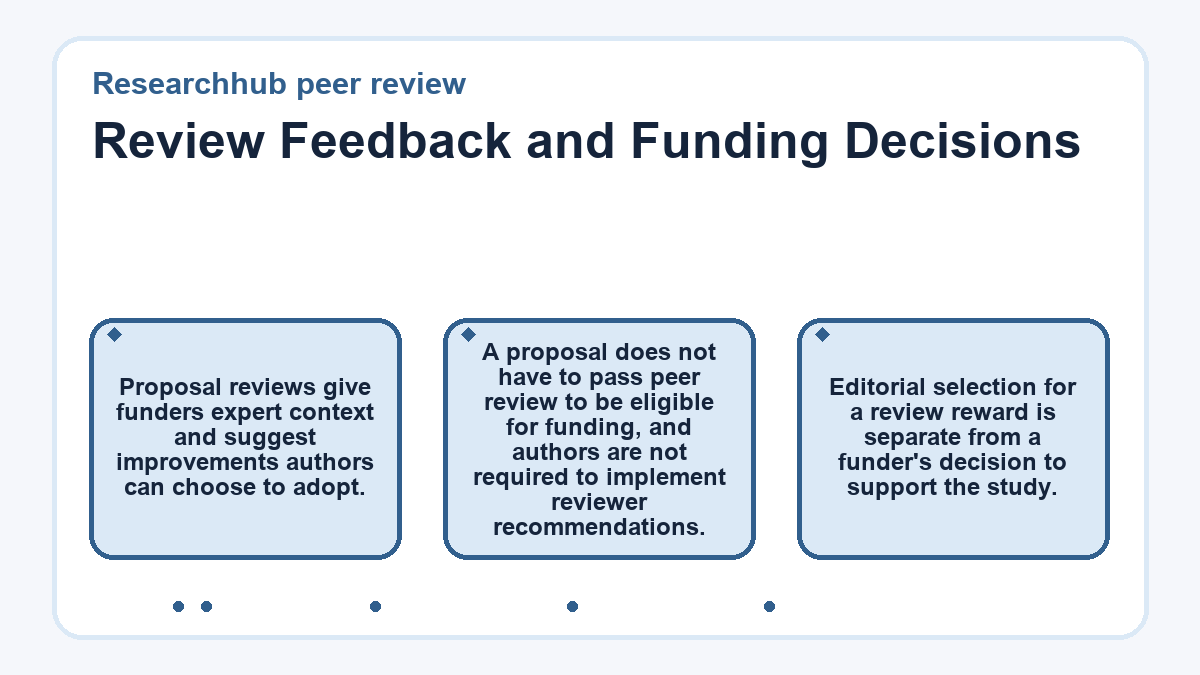
Proposal reviews give funders expert context and suggest improvements authors can choose to adopt. A proposal does not have to pass peer review to be eligible for funding, and authors are not required to implement reviewer recommendations. Editorial selection for a review reward is separate from a funder's decision to support the study.
Earlier Preprint Review Guidance
ResearchHub's 11 May 2025 guide, Peer Reviewing on ResearchHub, described preprint bounties with assessment prompts covering methods, results, and discussion. That manuscript-focused assessment differs from proposal review, which examines the expected impact and feasibility of planned work. The proposal program's submission limits and payment timing should remain separate from the terms described for historical preprint bounties.